




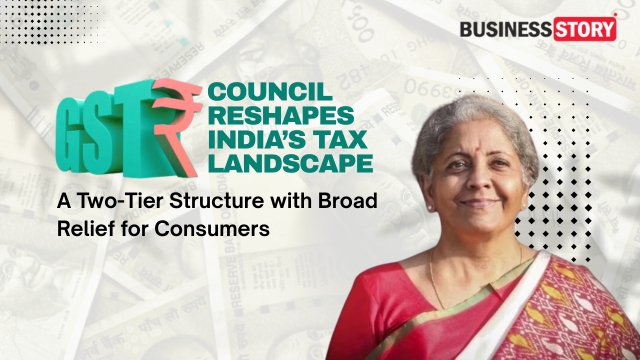


The Goods and Services Tax (GST) Council, chaired by Union Finance Minister Nirmala Sitharaman, has taken a landmark decision to simplify India’s indirect tax system by reducing the number of GST slabs. Starting September 22, 2025, India will move to a two-rate structure of 5% and 18%, replacing the existing four-tier system of 5%, 12%, 18%, and 28%. Alongside this, a special 40% rate has been carved out for sin and luxury goods such as tobacco, pan masala, aerated drinks with added sugar, and luxury vehicles.
This reform marks the most sweeping overhaul of GST since its launch in 2017 and is expected to bring relief to households, small businesses, and key industries while also addressing compliance challenges. Let’s break down what has changed, why it matters, and who gains or loses under the new regime.
Why the GST Council Went for Reform
The GST system, though revolutionary when it was launched, had become increasingly complex over the years. With four major slabs and multiple exceptions, compliance was a challenge for businesses, and confusion persisted among consumers. Calls for simplification had been growing louder, with experts and industry bodies pushing for rationalisation.
According to Finance Minister Sitharaman, the Council’s decision was driven by three goals:
- Simplification – A move from four slabs to two makes the tax structure easier to understand and comply with.
- Affordability for the common man – Items of mass consumption have largely been brought down to the 5% bracket, directly benefiting households.
- Revenue stability – While rates have been cut in many categories, the Council introduced a higher 40% slab for luxury and sin goods to ensure that revenue losses are contained.
Key Highlights of the New GST Structure
- Two core slabs: 5% and 18%.
- Special 40% slab: For sin and luxury goods such as pan masala, gutkha, cigarettes, carbonated beverages with added sugar, betting and gambling services, luxury cars, yachts, and aircraft for personal use.
- 0% category expanded: Life-saving drugs, individual life insurance, health-related products, and essential food items such as UHT milk, paneer, roti, and parathas have been made tax-free.
- Goods shifting to lower slabs: Items earlier under 12% and 28% have largely been migrated to 5% and 18%, making a wide basket of products cheaper.
What Has Become Cheaper
One of the biggest takeaways from the Council’s decision is the wide range of goods and services that will now attract lower taxes. These reductions are expected to put money back into the hands of consumers and stimulate demand.
1. Essential Food and Household Products
- Dairy: Condensed milk, butter, ghee, paneer, and cheese now move from 12% to 5% or even nil.
- Staples: Malt, starches, pasta, biscuits, chocolates, and cocoa products see rates cut from 12–18% to 5%.
- Dry fruits and nuts: Almonds, cashews, pistachios, dates, and hazelnuts drop from 12% to 5%.
- Packaged foods: Vegetable oils, edible spreads, sausages, and fish products have been shifted to the 5% slab.
- Snacks: Namkeens, bhujia, mixtures, and other pre-packaged snacks reduce from 18% to 5%.
2. Agriculture and Fertilisers
- Fertilisers: From 12–18% to just 5%, making farming inputs more affordable.
- Agricultural inputs: Seeds, crop nutrients, bio-pesticides, drip irrigation systems, and sprinklers have all been rationalised to 5%.
3. Medicines and Healthcare
- Life-saving drugs: Certain cancer drugs, medicines for rare diseases, and critical health products move to 0%.
- Medical devices: Oxygen, diagnostic kits, thermometers, glucometers, and corrective spectacles now attract only 5%.
- Insurance: All individual life insurance policies—term life, ULIPs, and endowments—are exempt from GST, improving affordability and boosting financial inclusion.
4. Consumer Durables and Daily-Use Goods
- Entry-level appliances: Some products earlier taxed at 28% are now down to 18%.
- Toiletries: Hair oil, shampoo, toothpaste, toilet soaps, shaving cream, and toothbrushes reduced to 5%.
- Footwear and textiles: A significant cut from 12% to 5%—a major relief for middle-class and low-income households.
Items Under the 0% Slab
The Council expanded the exemption list, especially for essentials. Items now tax-free include:
- Life-saving medicines and cancer drugs
- Individual life and health insurance
- UHT milk, paneer, chapati, roti, parotta, pizza bread, khakhra
- Educational supplies like maps, globes, pencils, sharpeners, crayons, exercise books, and erasers
Items Under the 5% Slab
The majority of mass-consumption products are now at 5%, including:
- Dairy items: Butter, ghee, cheese, spreads
- Toiletries: Shampoo, toothpaste, soaps, shaving products
- Packaged foods: Namkeens, biscuits, chocolates, vegetable oils
- Medical goods: Thermometers, diagnostic kits, glucometers, oxygen
- Agricultural equipment: Tractors, tractor tyres, irrigation systems
- Infant care: Feeding bottles, diapers, napkins
- Textiles and footwear
Items Under the 18% Slab
While relief is widespread, some higher-value goods remain at 18%:
- Motorcycles up to 350 cc
- Passenger cars (petrol/CNG under 1200 cc, diesel under 1500 cc)
- 3-wheeled vehicles and goods transport vehicles
- Air conditioners, washing machines, televisions above 32 inches
- Monitors, projectors, dishwashing machines
- Heavy-duty road tractors
Items Under the 40% Slab
The Council carved out this new bracket to ensure that luxury and harmful goods continue to bear the highest tax burden. Items here include:
- Pan masala, gutkha, chewing tobacco, bidis, cigarettes
- Aerated waters with sugar, caffeinated drinks, non-alcoholic flavoured beverages
- Motorcycles above 350 cc
- Yachts, private aircraft, and luxury cars
- Revolvers and pistols
- Betting, gambling, horse racing, casinos, online gaming
Economic Impact of the Reform
Relief for Households
Consumers are the immediate winners. Everyday expenses on food, toiletries, footwear, and insurance are expected to drop, offering relief amid inflationary pressures.
Boost to Manufacturing and Retail
With lower rates on textiles, footwear, fertilisers, and packaged foods, manufacturers expect higher demand. Retailers may also benefit from simplified billing and lower compliance costs.
Healthcare and Insurance Expansion
By exempting individual life and health insurance policies, the government has made financial protection more accessible, encouraging wider insurance adoption.
Agriculture Support
Reduced GST on fertilisers, seeds, and irrigation systems directly supports farmers, aligning with rural growth and food security goals.
Revenue Concerns
While consumers benefit, states like West Bengal have flagged concerns. Minister Chandrima Bhattacharya estimated revenue losses of nearly ₹477 billion due to these cuts. The Centre argues that the higher 40% slab, alongside improved compliance, will balance out the shortfall.
Political and Public Reactions
Prime Minister Narendra Modi welcomed the reforms, emphasising that the changes are “for the common man” and mark a step toward a more just and affordable tax system. Most states supported the decision unanimously, highlighting rare consensus in the GST Council.
Industry bodies like CII and FICCI have hailed the reform as “long overdue”, noting that simplification will improve ease of doing business. However, some economists caution that the real test will be in revenue collection and state compensation.
Challenges Ahead
Despite its promise, the reform faces hurdles:
- Revenue loss to states: The central government may need to strengthen the compensation mechanism.
- Transition costs: Businesses must reconfigure billing systems, update ERP software, and manage inventory transitions.
- Risk of misuse: Lower rates on some packaged foods may lead to classification disputes, as has been the case in the past.
- Enforcement of 40% slab: Tight valuation rules—shifting to Retail Sale Price (RSP)—will be crucial to prevent tax evasion in tobacco and luxury goods.
A Step Toward the Future
The rationalisation of GST slabs signals a maturing of India’s tax system. By making essentials cheaper, improving compliance, and discouraging harmful consumption, the reform attempts to balance economic growth with social equity.
For consumers, the message is clear: everyday goods—from milk to medicines—will become more affordable. For businesses, fewer slabs mean simpler compliance and potentially stronger demand. For the government, however, the balancing act of revenues and state compensation remains a challenge.As the new system rolls out on September 22, India takes another step in its journey toward a simpler, more efficient tax framework. The real impact will unfold in the months ahead, as households, businesses, and state governments adjust to the new GST era.